Stance Width & Toe Angle
Not measurableStance width and foot angle are a frontal/top-plane signal — the side view can't see them. Needs a front-view video.

Strong knee/hip flexion at the bottom, but the hip keypoint sits above the knee on every rep, so depth reads above parallel (a proxy — the keypoint runs above the hip crease). Depth and tempo wander rep-to-rep, and the ascent grinds through a deepening sticking region late in the set — a clear fatigue signature. Torso lean holds steady, so there's no good-morning. Knee valgus and any lateral hip shift need a front-view video.
Stance width and foot angle are a frontal/top-plane signal — the side view can't see them. Needs a front-view video.
A breathing/tension cue, not a position the keypoints can see — not measurable from video.
The hip keypoint sits ~19% of a femur length above the knee at the bottom on every rep, so typical reps read above parallel — and depth wanders ~21% of a femur between reps. Reported as an estimate: the hip keypoint is a proxy for the hip crease and the camera is rear-oblique, so this is a confident relative/consistency read, not a referee depth call.
Across the set the hip keypoint stays above the knee at the bottom — typical reps look above parallel.
Depth wanders about a fifth of a femur length between reps.
Hip keypoint is a proxy for the hip crease and the camera is rear-oblique, so treat this as relative, not a referee call.
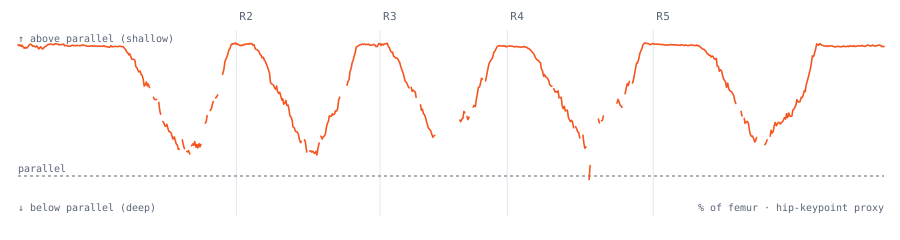
Hip-vs-knee depth (% of femur) through the set; the dashed line is parallel (hip keypoint level with the knee). The trace stays above the line — hip above knee — on every rep. Hip keypoint is a proxy for the hip crease, so read the shape and the parallel crossing, not an exact depth.
FixWork toward consistently breaking parallel — drill ankle/hip mobility and a controlled descent, and groove the same bottom position every rep so depth stops wandering.
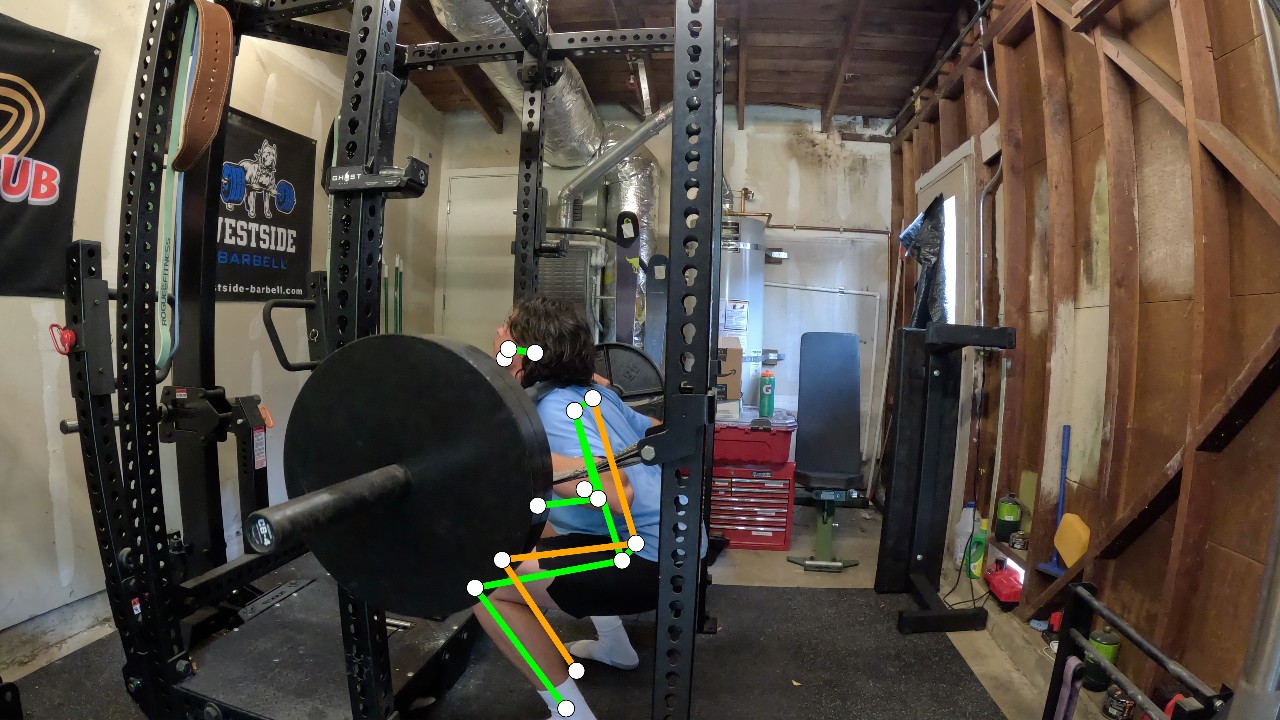
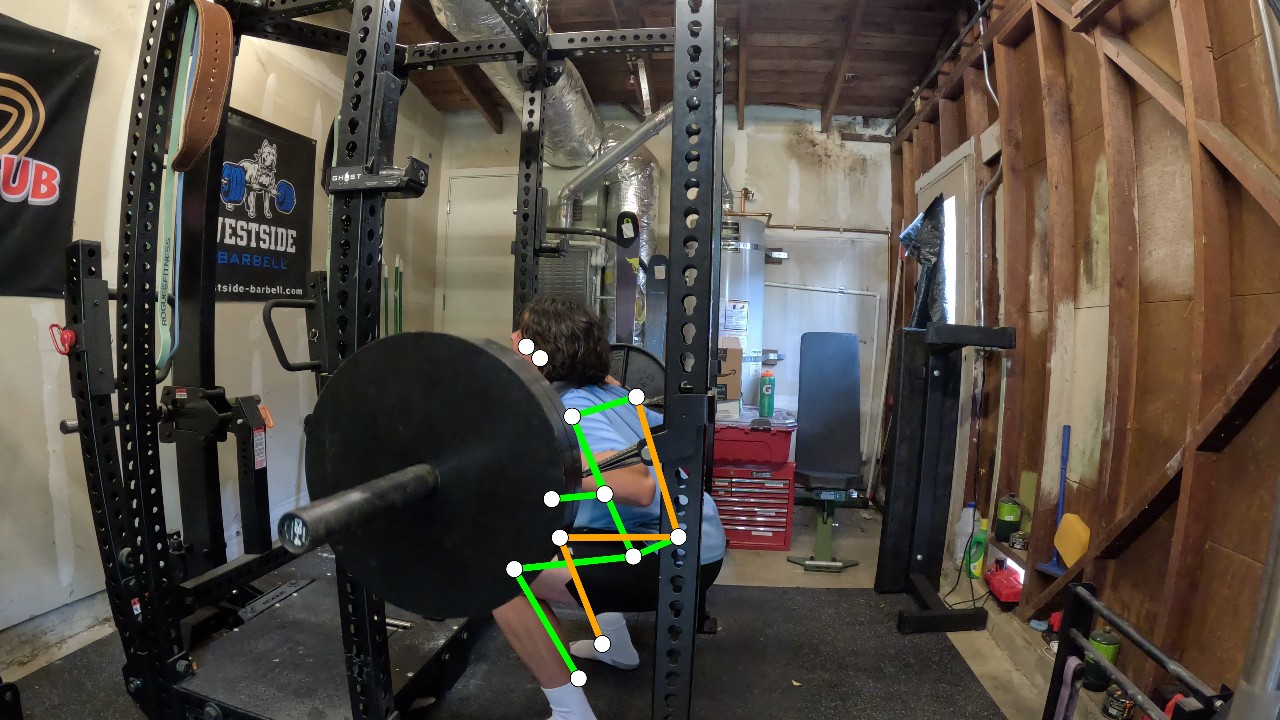
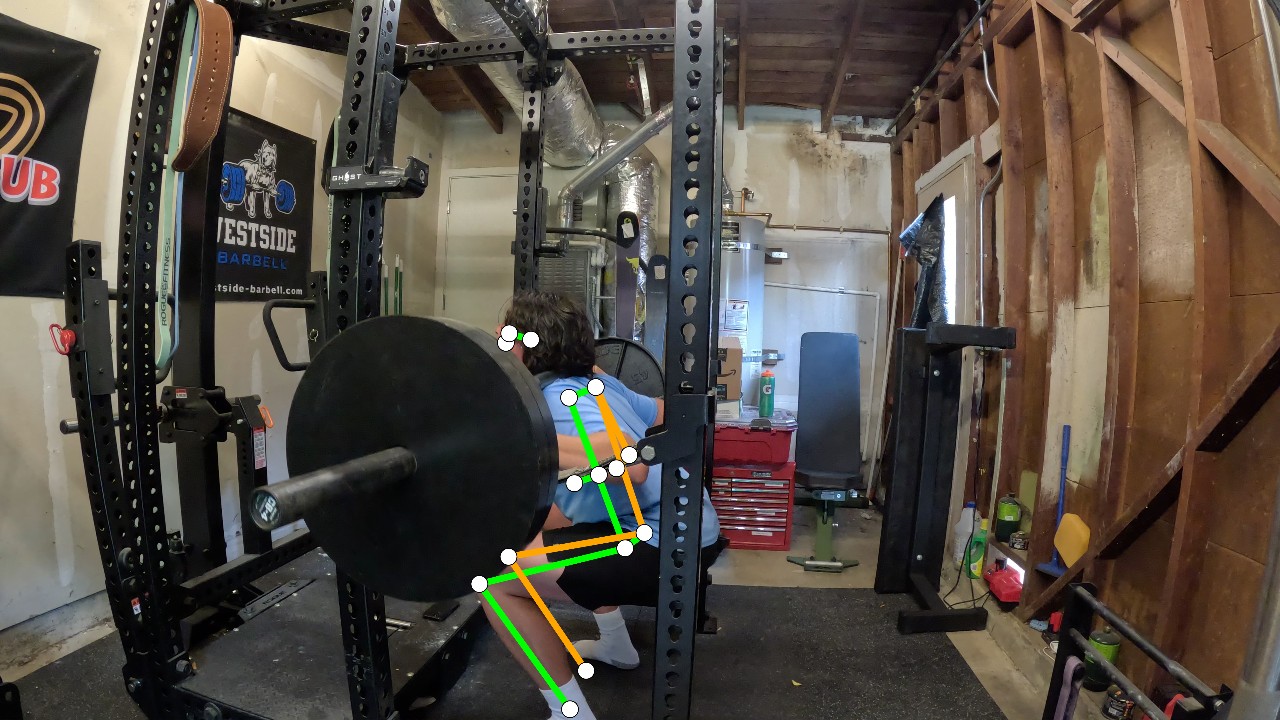
Bottom knee flexion ~64° (median), varying ~23° across reps — informational; the absolute value is anthropometry-dependent, so consistency is the signal.
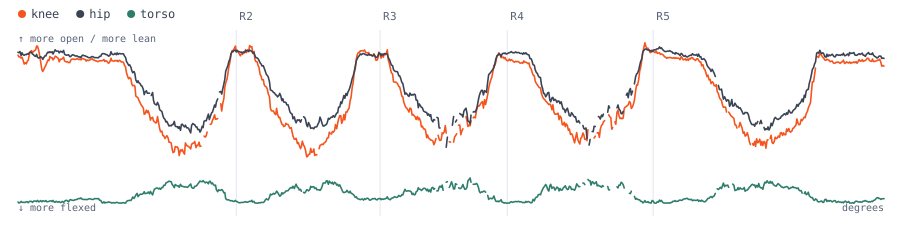
Knee (orange), hip (steel) and torso (teal) angle over the set — the coordinated hinge. The torso line stays flat, so lean isn't growing across reps.
Bottom hip flexion ~83° (median), varying ~32° across reps — informational, consistency is the signal.
Bottom torso lean ~18° from vertical and it doesn't grow across the set, so there's no drift — forward lean itself is individual (longer femurs lean more); the coachable fault would be lean increasing.
Bottom shin ~38° from vertical, knee travelling ~62% of a tibia horizontally from the ankle. Knees past the toes is normal and necessary — informational, not a fault.
The bar/shoulder travels ~43% of a femur length fore/aft over the midfoot through the rep. The squat bar path is sagittal, so the side view can see it — but the rear-oblique camera makes this horizontal signal low-confidence.
The bar leaves the midfoot and comes back through the rep — sitting back then pitching forward.
Eccentric 2.1–5.5s, concentric 1.5–2.2s, ecc:con ~1.2:1; ~39% rep-to-rep variation — the descent is much slower on the first rep and the tempo drifts across the set.
Descent ranges from ~2s to ~5.5s — the first rep is much slower.
The ascent duration is fairly consistent rep-to-rep.
Overall tempo varies about 39% between reps.
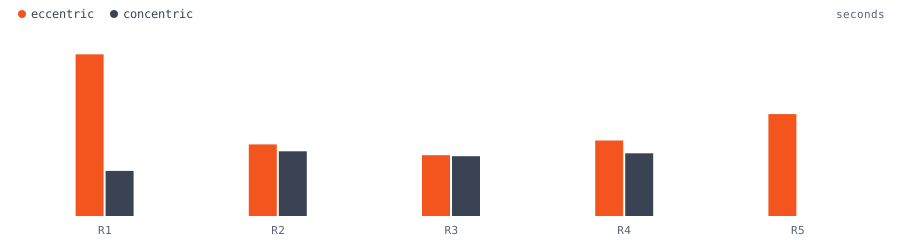
Descent (orange) vs ascent (steel) duration per rep. The first rep's descent towers over the rest — the ~39% rep-to-rep variation that flags tempo as inconsistent.
COCO-17 has no spine/pelvis landmarks, so butt wink isn't reliably measurable from video in any view — and the harm evidence is weak. Never asserted from keypoints.
The hips stall hard out of the hole on the way up, and the stall deepens from ~52% to ~100% below peak ascent velocity across the set — a clear fatigue signature (the sticking region disappearing into a full grind late).
Early reps slow about halfway out of the hole.
By the last reps the hips stall almost completely at the sticking point before recovering.
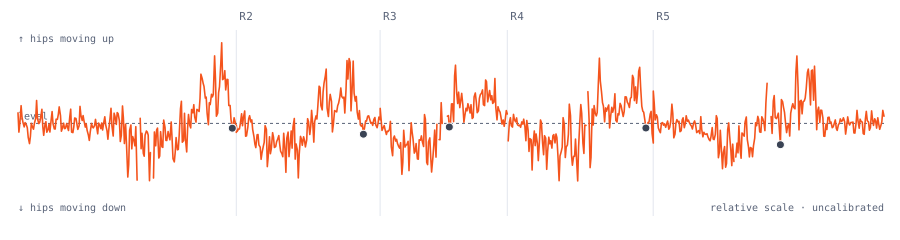
Hip velocity (above the dashed line = hips moving up). The steel dots mark each rep's sticking-region minimum; they sink toward the line on the last reps — the ascent stalling out as fatigue sets in. Relative scale (uncalibrated): read the shape, not the values.
FixThe deepening stall is fatigue — bank more reps in reserve or rest longer before this load; drive hard through the sticking point out of the hole.
The torso holds its angle from the bottom into mid-ascent (~5° more upright, not more forward), so the hips and chest rise together — no good-morning.
Bottom depth varies ~21% of a femur length across the five reps — depth wanders rep-to-rep rather than grooving a consistent bottom.
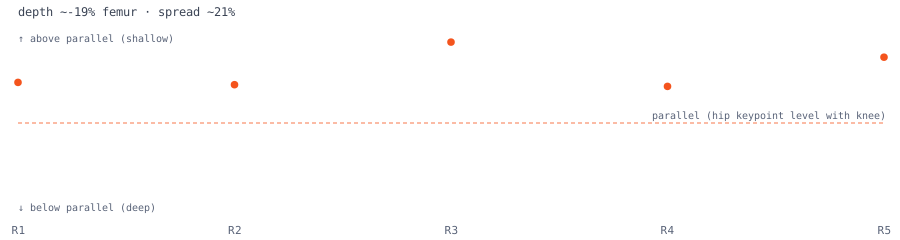
Each rep's bottom depth (% of femur) against the parallel line. The dots scatter rather than sitting in a tight row — depth wanders rep-to-rep. A row drifting up late would mean fatigue.
The biggest injury-relevant squat fault — but it's a frontal-plane signal, invisible from the side. Needs a front- or rear-view video.
A lateral pelvis shift reflects a side imbalance, but it's a frontal-plane signal — invisible from the side. Needs a front- or rear-view video.
Also not measurable from this view — Knee valgus, lateral hip shift, and stance width are frontal-plane signals a side camera can't see — they need a front- or rear-view video. Butt wink (lumbar flexion) and bracing aren't reliably measurable from any pose video.